

By Nick Bartlett, Realtor and owner of Freedom Rental Property Management in Maple Grove, Minnesota.
Short answer: when you turn your Minnesota home into a rental, you generally have about 3 years after moving out to sell and still exclude up to $250,000 of gain ($500,000 married). You start depreciating the house the day it is available for rent, and that depreciation is taxed at up to 25% when you sell. Rental losses can offset up to $25,000 of wages or dividends if your income is under $100,000, and your property tax changes after the next January 2 assessment.
Key takeaways
- The capital gains exclusion requires living in the home 2 of the 5 years before the sale, which usually leaves about a 3-year rental window.
- Depreciation starts at conversion, not purchase, using the lower of your cost or the market value that day, over 27.5 years.
- Depreciation recapture is taxed at up to 25% federally when you sell, but it is wiped out if heirs inherit the property at your death.
- Passive rental losses offset wages and dividends only through the $25,000 allowance, which phases out between $100,000 and $150,000 of income. Unused losses carry forward.
- In Minnesota, a single-family rental pays the same class rate as a homestead but loses the homestead market value exclusion and refund. Notify your county assessor within 30 days of moving out.
Most of the owners who call us are not seasoned investors. They are people who got a new job, bought a bigger house, moved in with a partner, or listed their home and it did not sell. Instead of selling, they decide to keep the house and rent it out. Some people call that an accidental landlord. I just call it a smart way to hold on to an appreciating asset and a low interest rate.
The moment your home stops being your home, though, the tax rules change. Some of the changes work in your favor, some can cost you real money if you miss a deadline, and almost none of them are explained at closing or by the person who helped you list the house for rent.
This post walks through the questions I hear most from first-time landlords in the Twin Cities: how long you can rent before you lose the capital gains exclusion, how depreciation and recapture work, what you can now deduct, what happens to rental losses, and when your Minnesota property tax bill goes up.
A quick note before we start: I am a property manager and a Realtor, not a CPA or tax attorney. Everything here is general information pulled from IRS publications and Minnesota sources, which I link throughout. Your situation will have details that matter, so take this list to your tax preparer before you file.
How long can you rent your home and still avoid capital gains tax?
How the 2-out-of-5-year rule works
When you sell a home you lived in, federal law lets you exclude up to $250,000 of gain, or $500,000 if you are married filing jointly. To get the full amount you have to have owned the home and lived in it as your main home for at least 24 months out of the 5 years before the sale date, and you cannot have used the exclusion on another home in the prior 2 years. For a married couple, only one spouse needs to meet the ownership test, but both have to meet the residence test. The details are in IRS Publication 523.
Here is the part most people miss: the 5-year lookback keeps running after you move out. If you lived in the house for 2 years and then rented it, you have roughly 3 years from your move-out date to sell and still claim the full exclusion. Live there longer than 2 years and the window is a little shorter on the back end, because only the last 5 years count. Sell one day too late and the exclusion is gone entirely.
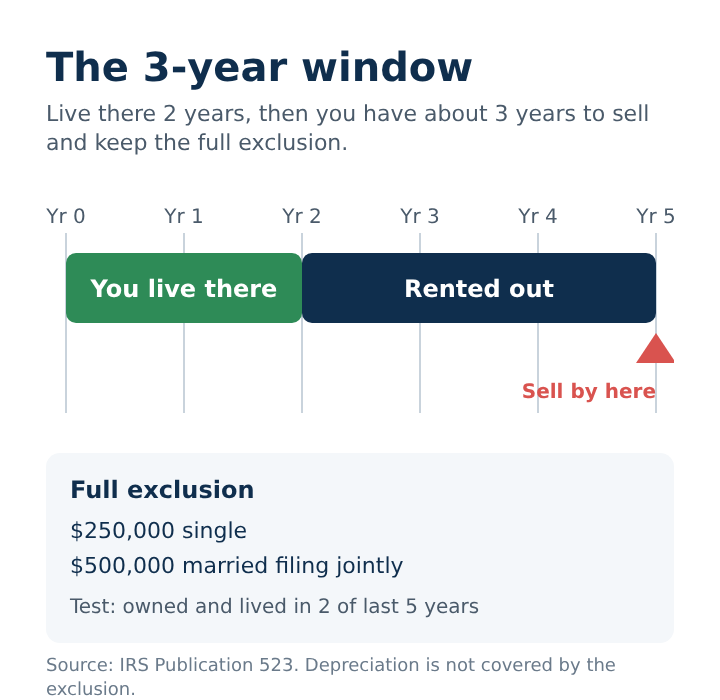
Good news on the rental time itself. Since 2009, the tax code reduces the exclusion for periods of “nonqualified use,” which includes renting. But rental time after the last date you lived in the home, within that 5-year window, is specifically not counted as nonqualified use. So if you lived there first and then rented it, you generally keep the full exclusion as long as you sell inside the window.
It works differently in reverse. If you rent the house out, move back in, and sell later, the rental years before your return can count against you and only part of the gain may be excluded. Moving back in does not simply reset the clock.
If you miss the window or plan to keep investing in rentals, a 1031 exchange may let you defer the gain into another investment property. The IRS even allows the exclusion and a 1031 exchange to be combined on a former home that became a rental, which Publication 523 covers under the like-kind exchange section. That is a conversation for your CPA and a qualified intermediary before you list. If you are still deciding whether to keep the house at all, my post on whether to sell or rent your house walks through the numbers.
How does depreciation work when you turn your home into a rental?
How rental depreciation is calculated
Once the house is a rental, you get to deduct part of the cost of the building every year even though you are not spending anything. That is depreciation, and for most first-time landlords it is the single largest deduction on their return.
Residential rental buildings are depreciated over 27.5 years. Land is never depreciated, so you have to split the value between land and building. Many owners use the ratio on their county property tax statement to make that split, which IRS Publication 527 allows when you do not have a better number.
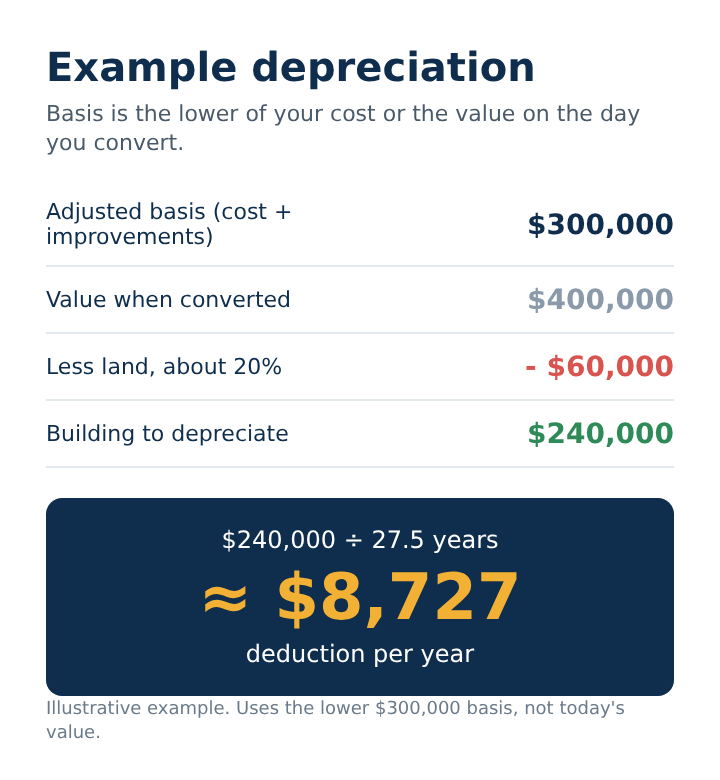
For a home that used to be your residence, the starting point is the lower of your adjusted basis (what you paid plus improvements) or the fair market value on the day you converted it. If your home went up in value, you depreciate from your original cost, not today’s price.
Example: you paid $300,000 including improvements and the house is worth $400,000 when you move out. Your basis is the lower number, $300,000. If the county values the land at about 20%, the building portion is $240,000, and $240,000 divided by 27.5 years is about $8,727 of depreciation a year.
A question I get a lot: does depreciation start from when you bought the house, or when you converted it? It starts at the conversion. The years you lived there do not count, and you do not get to catch up on them. The IRS treats the home as placed in service as a rental on the date it is ready and available for rent, not when a tenant moves in, and the full 27.5-year schedule starts from that date. Publication 527 uses almost this exact example: the owner moves out in July, does repairs in August and September, lists it for rent on October 1, and the clock starts October 1.
Two things to do the month you move out:
- Get a broker price opinion, comparative market analysis or appraisal so you can document fair market value on the conversion date. If the house ever sells at a loss, that number matters too, because you cannot deduct a drop in value that happened while you lived there.
- Pull together your purchase closing statement and receipts for improvements like a new roof, furnace, windows or a finished basement. Those add to your basis and your future depreciation.
One more thing I always tell owners: take the depreciation. The IRS reduces your basis by the depreciation you were “allowed or allowable,” whether or not you actually claimed it. Skip it and you lose the deduction now and still pay the recapture tax later.
Inherited a house you plan to rent? The basis works differently
Many owners we talk to did not buy the house they are renting. They inherited it from a parent. The rules for an inherited home are more generous than most people realize.
Your basis in an inherited home is generally its fair market value on the date of death, not what your parent paid for it. This is the “stepped-up basis” you may have heard about, and IRS Publication 523 and Publication 551 explain it. If an estate tax return was filed, the value reported on it is your basis. If your parent bought the house in 1985 for $90,000 and it was worth $380,000 when they passed, your starting basis is $380,000, and the $290,000 of growth during their lifetime is never taxed.
For depreciation, the same rule as any converted home applies: you use the lower of your basis or the fair market value on the day you make it available for rent, and you subtract the land. If you inherit in March and list it for rent in June, those values are usually close, so most heirs depreciate from roughly the date-of-death value. Depreciation starts when the home is ready and available for rent, not on the date of death.
A few details that matter:
- Get a date-of-death appraisal. It supports your basis for depreciation and for a future sale. It is much harder to reconstruct years later.
- If the house was already a rental, the step-up generally applies to the building too. You start a fresh 27.5-year depreciation schedule from your new basis, and your parent’s past depreciation does not carry over to you as recapture.
- Surviving spouses are different. When a home was owned jointly, usually only the deceased spouse’s half gets a new basis. The survivor’s half keeps its original basis.
- Inherited property is always long term for capital gains purposes, no matter how soon you sell.
- The home sale exclusion does not transfer to you. To use it, you would have to own the home and live in it yourself for 2 of the 5 years before selling.
Depreciation recapture: the bill that comes due when you sell
Why the exclusion does not cover depreciation
Depreciation is not free money. It is a deduction now that the IRS partially takes back when you sell, and this is where people get surprised even when they sell inside the 3-year window.
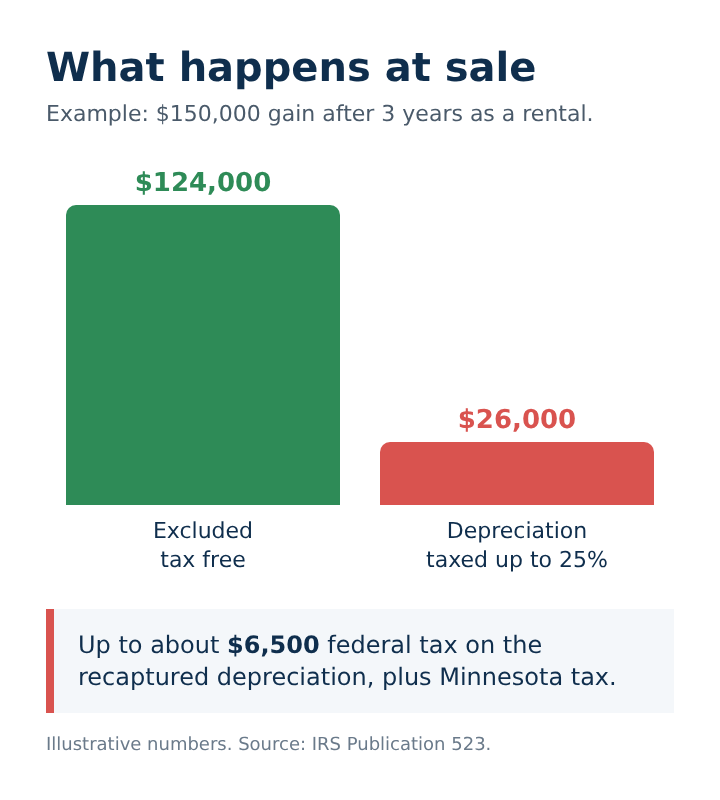
The home sale exclusion does not cover depreciation claimed after May 6, 1997. That portion of your gain, called unrecaptured Section 1250 gain, is taxed at a federal rate of up to 25%, even if every other dollar of your profit is tax free.
Example: three years of depreciation at about $8,727 a year on a $240,000 building is roughly $26,000. If you sell with a $150,000 gain inside the 3-year window, about $124,000 is excluded, but the $26,000 of depreciation could cost you up to about $6,500 in federal tax, plus Minnesota tax. You still came out ahead, because you got the deductions while you owned it, but plan for it.
Minnesota does not give capital gains a lower rate. According to the Tax Foundation, the state taxes gains as ordinary income, with an additional 1% tax on net investment income over $1 million. Higher earners should also look at the federal 3.8% net investment income tax, which can apply to net rental income and to the taxable gain when you sell once your modified adjusted gross income is over $200,000 single or $250,000 married filing jointly.
Why many investors hold rentals until they die
Here is the strategy a lot of long-time investors use, and it is worth knowing even if you are years away from it. If you keep the rental until you pass away, your heirs generally receive it with a stepped-up basis equal to its fair market value on the date of death, under Internal Revenue Code section 1014. Both the appreciation and every dollar of depreciation you took during your lifetime are effectively erased for income tax purposes. The depreciation recapture never comes due. IRS Publication 551 covers how inherited basis is figured.
Example: you bought a rental for $200,000, claimed $120,000 of depreciation over the years, and it is worth $500,000 when you die. If you had sold it, you would have had about a $420,000 gain, including $120,000 of recapture taxed at up to 25%. Your heirs instead start with a $500,000 basis. If they sell soon after for $500,000, they generally owe no capital gains tax and no recapture. If they keep renting it, they start a fresh 27.5-year depreciation schedule on the new building value.
That is why you hear investors talk about “buy, hold, and never sell,” often combined with 1031 exchanges during their lifetime to defer gains, and borrowing against equity instead of selling to pull cash out. A few cautions before you plan around it:
- Gifting is different. If you give the property to your kids while you are alive, they generally take over your basis, including the reduced basis from depreciation. The step-up only happens at death.
- Estate tax is separate. The federal estate tax exemption is $15 million per person for 2026 under the IRS estate tax rules, but Minnesota has its own estate tax that starts at $3 million, according to the Minnesota Department of Revenue. Families with several rentals can hit the Minnesota threshold.
- Suspended passive losses are mostly lost at death. Under section 469, carried-forward losses are allowed on the final return only to the extent they exceed the step-up in basis. If you have a large loss bucket, using it while you are alive may be worth more.
- Jointly owned property between spouses usually steps up only the half owned by the spouse who died.
This is estate planning, not just tax planning, so bring your CPA and an estate planning attorney into the conversation.
Expenses that turn into tax deductions
What you can deduct now
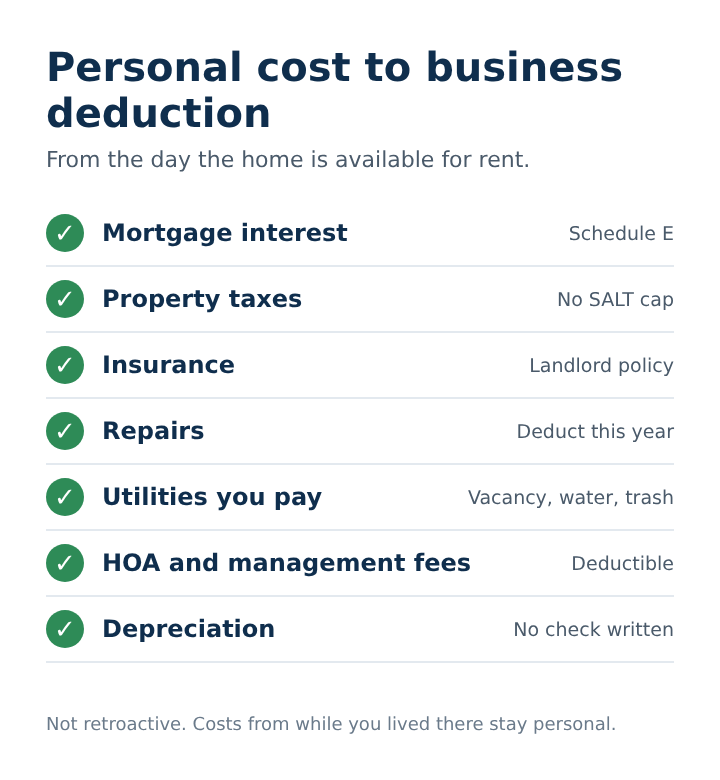
While you lived in the house, most of what you spent on it was a personal expense. Once it is a rental, the same categories of spending become business expenses you deduct against the rent on Schedule E. This is where a lot of new landlords find money they did not expect.
To be clear, this is not retroactive. The water bill you paid while you lived there is still personal. But from the date the home is available for rent forward, these are generally deductible:
- Mortgage interest
- Property taxes
- Landlord insurance
- Repairs and maintenance
- Utilities you pay, such as during vacancy or water, sewer and trash
- HOA dues and property management fees
- Advertising, lawn care and snow removal
- Tax prep for your Schedule E and mileage to manage the property
Two of those deserve a second look. If you took the standard deduction as a homeowner, your mortgage interest and property taxes probably did nothing for you. On Schedule E they reduce your rental income dollar for dollar. And property taxes on a rental are a business expense, so they are not squeezed by the state and local tax (SALT) cap that limits itemized deductions.
Costs to prepare the house before it is available for rent are a gray area. Publication 527 says you can deduct ordinary expenses for managing and maintaining a rental from the time you make it available for rent. Some prep costs may need to be added to your basis instead. The practical takeaway is to get the home listed for rent promptly and keep your receipts.
Also know the difference between a repair and an improvement. Fixing a leaking faucet is a repair you deduct this year. A new roof, furnace or kitchen is an improvement you depreciate over time. The IRS has two safe harbors that can help, the de minimis safe harbor and the routine maintenance safe harbor, explained on its tangible property regulations FAQ. Ask your preparer whether to elect them.
Can rental losses offset your wages or dividends?
The $25,000 special allowance
Between depreciation, mortgage interest and property taxes, a lot of converted homes show a loss on paper in the first few years even when the rent covers the payment. Whether you can use that loss right away depends on the passive activity rules in IRS Publication 925.
Rental real estate is a passive activity for most people. As a general rule, passive losses can only offset passive income. Your wages are not passive. Your dividends and interest are not passive either; the IRS calls them portfolio income. So without an exception, a rental loss cannot reduce the tax on your paycheck or your investment account.
The big exception is the $25,000 special allowance. If you actively participate, you can deduct up to $25,000 of rental losses against your nonpassive income, which includes both wages and dividends. Active participation is a low bar: approving tenants, setting rent and approving repairs all count, and you still qualify when a property manager handles the day-to-day as long as you make those decisions and own at least 10%.
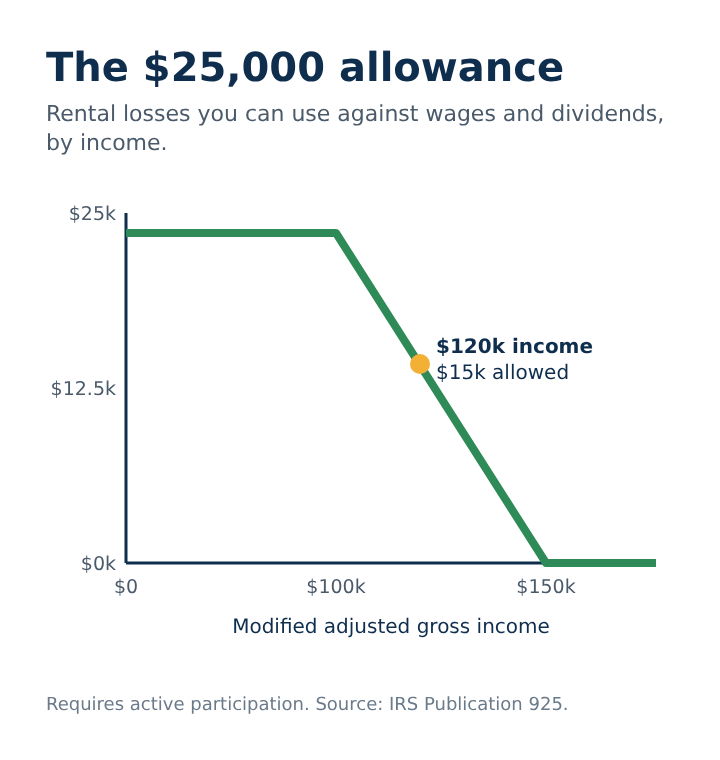
The allowance shrinks as your income rises. It is reduced by 50 cents for every dollar of modified adjusted gross income over $100,000, and it is gone at $150,000. Publication 925’s own example: a single filer with $120,000 of salary and a $31,000 rental loss can deduct $15,000 this year and carries the other $16,000 forward. If you are married filing separately and lived with your spouse at any point in the year, the allowance is zero.
The separate bucket: carrying passive losses forward
How suspended losses carry forward
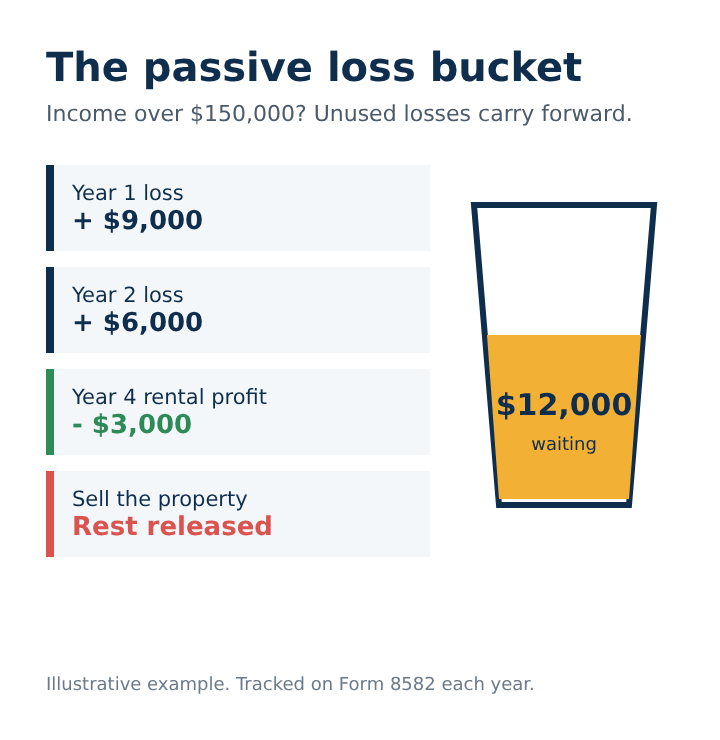
If your income is too high for the allowance, your rental loss does not disappear. Think of it as going into a separate bucket that sits outside your earned income. The disallowed loss carries forward to next year, and the year after, with no expiration date.
That bucket gets emptied in two ways:
- Future passive income. When the rental starts producing a profit, which usually happens as rents rise and the mortgage balance falls, the stored losses offset that profit first. So do profits from other passive investments.
- Selling the property. When you dispose of your entire interest in a taxable sale to an unrelated buyer, the remaining suspended losses are generally released and can offset any kind of income that year.
Example: with income over $150,000, a $9,000 loss in year one and a $6,000 loss in year two go into the bucket, for $15,000 total. If the rental earns a $3,000 profit in year four, the bucket covers it, leaving $12,000 waiting until you have more passive income or sell.
Keep track of the bucket every year. It lives on Form 8582, and if you switch tax preparers or software, the carryforward is easy to lose. Also ask your CPA how a sale that uses the home sale exclusion, or a 1031 exchange, affects releasing those losses, because the answer depends on how the gain is treated.
You may have heard about real estate professional status, which lets losses offset any income. It requires more than 750 hours a year in real estate businesses and more than half of all your working time, so it rarely fits someone with a full-time job outside real estate.
When do Minnesota property taxes go up after you move out?
The January 2 assessment date
Minnesota classifies every property based on how it is used on the January 2 assessment date. Homestead status requires that you own the home and live in it as your primary residence. Once you move out, it is not your homestead anymore.
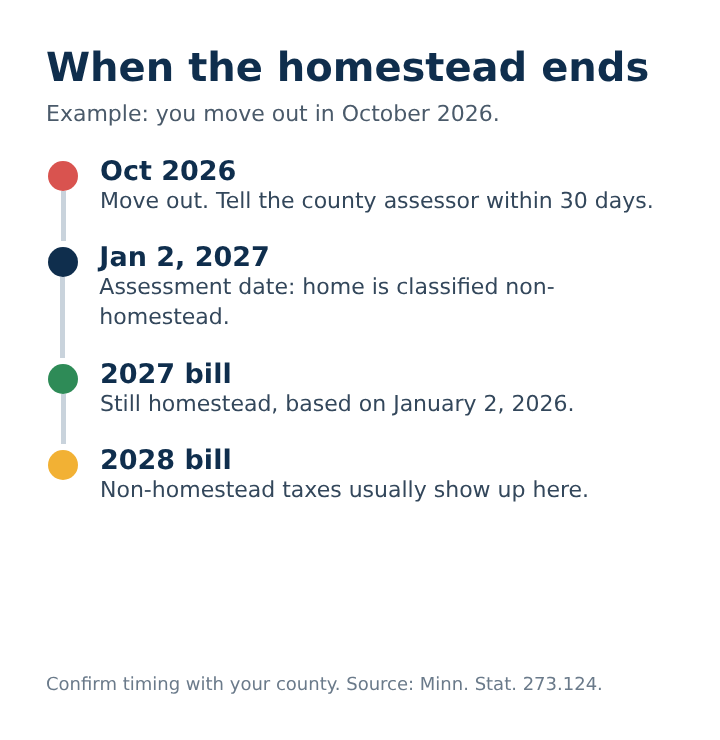
State law requires you to notify your county assessor within 30 days when you stop occupying your homestead. Under Minnesota Statutes section 273.124, if you do not, you can be billed the tax at the correct classification plus a penalty, and county assessors describe that penalty as equal to the tax difference. Make the call or send the form the month you move.
The higher bill usually shows up later than people expect, because Minnesota taxes are paid a year behind the assessment. Move out in the fall of 2026 and the January 2, 2027 assessment classifies the home as non-homestead, which typically affects the taxes you pay in 2028. Your 2027 bill is based on the January 2, 2026 assessment, when you still lived there. Every county handles the details a little differently, so confirm with your assessor.
How much more will you pay? Many people assume the county charges rentals a higher tax rate. It does not work that way in Minnesota. The local tax rate set by your county, city and school district is the same for every class of property in that taxing area. The difference comes from the state’s classification rate, which turns your market value into the tax base that local rate is applied to.
For a single-family house, the Minnesota Department of Revenue class rate table shows a non-homestead single unit (class 4bb) uses the same 1.00% class rate on the first $500,000 of value, and 1.25% above that, as a homestead. A duplex or triplex you do not live in is different: it is class 4b at 1.25% on all of its value, so it pays about 25% more tax capacity than the same value as a homestead.
| Minnesota property type (taxes payable 2026) | Class rate | Market value exclusion | Homestead Credit Refund |
|---|---|---|---|
| Homestead (class 1a) | 1.00% to $500,000, 1.25% above | Yes, up to $38,000 | Yes, if income qualifies |
| Single-family rental (class 4bb) | 1.00% to $500,000, 1.25% above | No | No |
| Duplex or triplex rental (class 4b) | 1.25% | No | No |
What you do lose:
- The homestead market value exclusion. For homestead property it removes up to $38,000 of value from taxation, shrinking as value rises and disappearing at $517,200, according to the Department of Revenue. On a $400,000 home the exclusion is about $10,550 of value, which at typical metro tax rates is often worth somewhere around $100 to $150 a year. Lower-value homes lose more.
- The Homestead Credit Refund. If your income qualified you for a property tax refund on Form M1PR, that ends with homestead status.
In a House Research example comparing equal-value properties for taxes payable in 2025, the non-homestead home paid roughly 9% more. And remember, the property tax on the rental is now a deduction on Schedule E.
Other tax items first-time landlords miss
- Security deposits are not income when you collect them, as long as you plan to return them. Any part you keep for damage becomes income that year. Rent paid in advance is income when you receive it, even if it covers next year.
- The qualified business income deduction. Some rental owners can deduct up to 20% of their net rental income under Section 199A. The IRS has a safe harbor for rentals with at least 250 hours of services a year, and services by a property manager can count. See the IRS QBI page and ask whether your rental qualifies.
- Selling at a loss. If the market drops, your basis for figuring a loss is limited to the fair market value on the conversion date. Only the drop that happens after you started renting can be deducted.
- Keep it separate. A dedicated bank account and clean records make Schedule E, depreciation and the passive loss carryforward far easier for you and your preparer.
A few non-tax items while you are at it
These are not tax questions, but they come up in the same conversation every time:
- Insurance. A homeowner’s policy is written for an owner-occupied home. Switch to a landlord or dwelling policy before the first tenant moves in, and require renters insurance. My post on adding your property manager as additional insured covers why that matters too.
- Your mortgage. Most owner-occupied loans require you to live in the home for a period after closing. Read your loan documents and talk to your lender if you have not lived there long.
- Rental licensing. Many Twin Cities suburbs require a rental license and inspection before a tenant moves in. Build that time into your plan.
Frequently asked questions
How long can I rent out my house and still avoid capital gains tax?
If you lived in the home for at least 2 of the 5 years before the sale, you can generally rent it for up to about 3 years after moving out and still exclude up to $250,000 of gain, or $500,000 if married filing jointly. Depreciation claimed while it was a rental is still taxed at up to 25%.
When does depreciation start on a home converted to a rental?
Depreciation starts on the date the home is ready and available for rent, not the date you bought it and not the date a tenant moves in. The years you lived in the home do not count. Residential rental buildings are depreciated over 27.5 years.
What is the depreciation basis for a house that used to be my home?
Your depreciation basis is the lower of your adjusted basis (purchase price plus improvements) or the fair market value on the date you convert it to a rental, minus the value of the land.
Do heirs pay depreciation recapture on an inherited rental property?
Generally no. Heirs receive a stepped-up basis equal to the property’s fair market value on the date of death, which erases the prior owner’s depreciation and appreciation for income tax purposes. Property given as a gift during life does not get this step-up.
Can rental losses offset my W-2 wages or dividends?
Yes, up to $25,000 a year if you actively participate in managing the rental and your modified adjusted gross income is under $100,000. The allowance phases out completely at $150,000. Losses you cannot use carry forward until you have passive income or sell the property.
Are property taxes higher on a rental than a homestead in Minnesota?
A single-family rental uses the same class rate as a homestead, but it loses the homestead market value exclusion and the Homestead Credit Refund, so the bill is usually somewhat higher. Duplexes and triplexes you do not live in are taxed at a higher 1.25% class rate.
What this means for you
If you are about to move out and rent your home, here is the short version:
- Write down your move-out date and the date your 3-year window closes. Put it on your calendar.
- Document the fair market value on the conversion date and gather your improvement receipts.
- Take depreciation every year, and plan for recapture when you sell.
- Track every rental expense from the day the home is available for rent.
- Know whether your income lets you use the $25,000 allowance, and keep an eye on your passive loss carryforward.
- Notify your county assessor within 30 days of moving out.
- Sit down with a CPA before the end of your first rental year, not in April.
Renting your home can be a great way to build wealth, and if you are still on the fence, my post on what to do when your house will not sell and the one on when to sell an investment property may help. If you would like to know what your home would rent for, request a free rental analysis, or contact us and we can talk through your plan. We send our owners clean year-end statements and handle the tenant paperwork, so tax season is much easier for you and your CPA.